
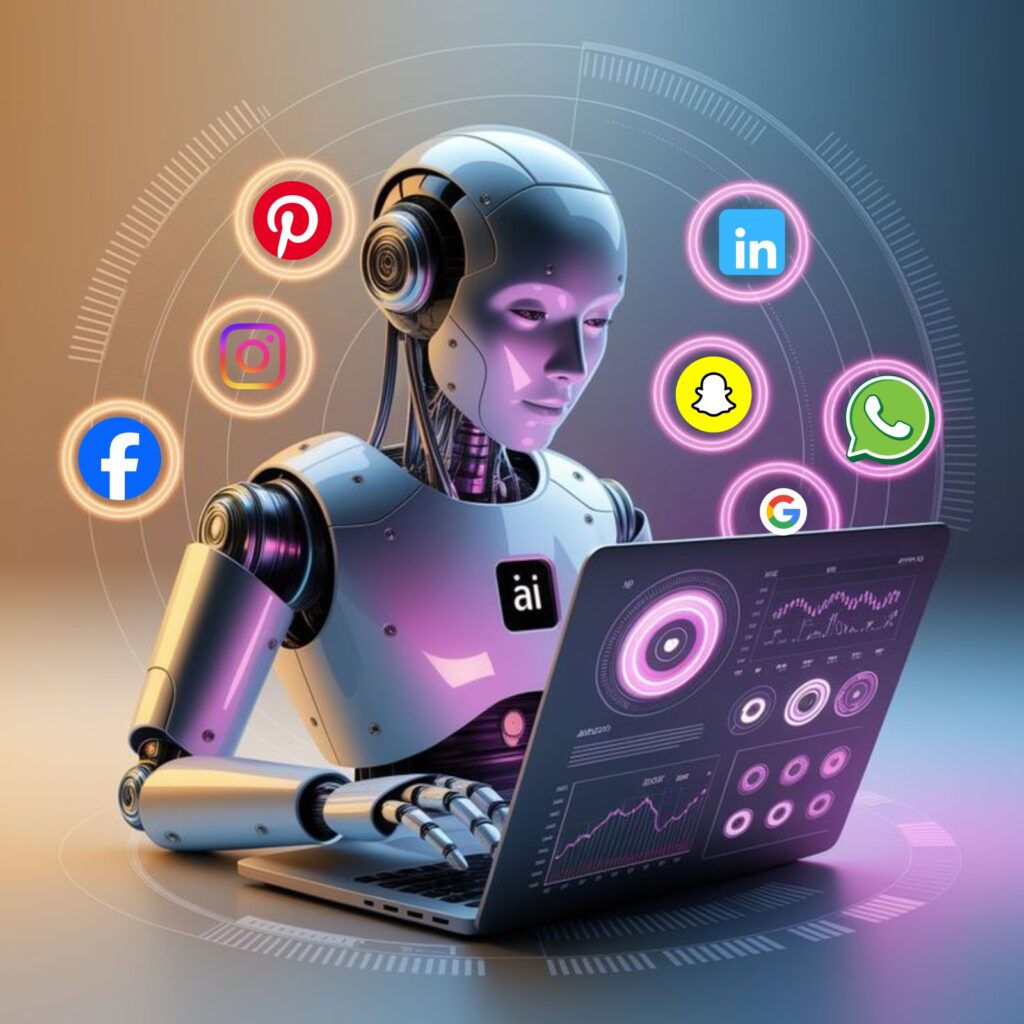
Digital marketing has always been about reaching the right person, with the right message, at the right time. What has changed in recent years is how quickly marketers can do that work.
In 2026, AI in digital marketing is no longer something businesses are simply experimenting with. AI is becoming part of everyday marketing activities, from researching customers and writing content to analyzing campaigns, creating advertisements and answering customer questions.
Google is adding more AI and agentic capabilities to Google Ads and Google Analytics, while Meta is expanding AI across advertising, content creation and business messaging. These developments show that AI is becoming part of the actual marketing infrastructure businesses use, not just another effective tool.
But there is an important point that often gets lost in the excitement around AI: using AI does not automatically make marketing better.
A marketer who understands customers, positioning, content, advertising and analytics can use AI to work faster and make better decisions. Someone who simply asks an AI tool to create everything and publishes the output without checking it can just produce more average content, faster.
That difference is what this guide is about.
Whether you are a beginner learning digital marketing, a freelancer handling clients, a business owner trying to generate leads, or an experienced marketer looking to improve your workflow, this article explains how AI can actually be used to grow a business in 2026.
What Is AI in Digital Marketing?
AI in digital marketing means using artificial intelligence to support or automate marketing activities that traditionally required significant amounts of manual work.
These activities can include:
- Customer research
- Content creation
- SEO research
- Social media management
- Advertising
- Email marketing
- Lead generation
- Customer support
- Data analysis
- Personalization
- Campaign optimization
For example, instead of spending several hours manually analyzing a campaign report, a marketer can use AI to identify unusual changes, summarize performance and highlight areas that deserve attention.
Similarly, an AI tool can help generate ten variations of an advertising headline in seconds. But the marketer still needs to decide which message actually fits the audience and the brand.
That is an important distinction. AI can assist with execution, but marketing strategy still requires context and judgment.
Generative AI vs Predictive AI vs AI Agents
Not all AI works in exactly the same way.
Generatihttps://youtu.be/NRmAXDWJVnU?si=g1lC-KiK8FFfau65ve AI creates new content such as text, images, videos, audio or ideas.
Predictive AI analyzes existing data to identify patterns and make predictions. For example, it may help identify customers who are more likely to convert.
AI agents are designed to go a step further by handling multi-step tasks with less direct human intervention.
The marketing industry is increasingly moving toward this third category. Google, for example, introduced agentic capabilities in Google Ads and Google Analytics in 2026 to help marketers discover insights and take actions within their marketing workflows.
How AI Is Changing Digital Marketing in 2026
The biggest change is not simply that marketers have access to better writing or image-generation tools.
The bigger change is that AI is becoming integrated into the platforms marketers already use.
Google is expanding AI-powered advertising capabilities through products such as AI Max for Search campaigns. Meta is similarly using AI for ad ranking, creative generation, campaign optimization and business messaging.
This creates a shift from manual execution to AI-assisted execution, and increasingly from manual analysis to AI-assisted decision-making.
For marketers, this means spending less time on repetitive work and more time on strategy, creative thinking, customer understanding and testing.
However, the marketer’s role does not disappear. Instead, the skill set changes.
How Businesses Can Use AI in Digital Marketing
AI can be applied to almost every stage of the customer journey. The key is knowing where it actually provides value.
1. AI for Market Research and Customer Analysis
Before creating an advertisement or social media campaign, businesses need to understand their customers.
AI can help marketers organize and analyze information such as customer reviews, survey responses, competitor websites, social media comments, search queries, product feedback, frequently asked questions and customer support conversations.
For example, imagine a local fitness center wants to attract more customers. Instead of immediately creating an Instagram campaign, the marketer could use customer research to identify common concerns such as not knowing where to start, lack of time, price concerns or discomfort around experienced gym-goers.
Those insights can then become the foundation of the marketing strategy.
AI helps organize the information. The marketer turns that information into a useful strategy.
2. AI for Content Marketing
Content creation is one of the most obvious applications of AI.
AI can help marketers with blog ideas, content outlines, social media captions, video scripts, email drafts, content repurposing, headline variations and content briefs.
Suppose a digital marketing agency publishes a detailed article about SEO. The same article could potentially be transformed into five Instagram posts, three LinkedIn posts, two short-form video scripts, a newsletter, a carousel and a checklist.
Instead of creating every piece from scratch, AI can help repurpose the original material.
That is where AI becomes genuinely useful.
Should Businesses Publish 100% AI-Generated Content?
This is where businesses need to be careful.
Using AI to assist with content does not mean a business should publish everything an AI tool produces without reviewing it.
AI-generated content can contain incorrect facts, generic statements, repetitive language, outdated information, made-up references, weak examples and an unnatural brand voice.
Google’s guidance is particularly important here. Its spam policies state that generating many pages primarily to manipulate search rankings, including through generative AI, can qualify as scaled content abuse when those pages provide little value to users.
The better approach is simple: use AI to accelerate content creation, not to eliminate human thinking.
3. AI for SEO
SEO is another area where AI can save marketers a considerable amount of time.
AI can assist with keyword research, search intent analysis, topic clustering, content planning, competitor analysis, content gap identification, internal linking ideas, on-page SEO and content optimization.
For example, instead of looking at a list of 500 keywords individually, a marketer can use AI to group them according to search intent.
One group might contain informational searches. Another could contain commercial searches. A third could contain local searches.
This makes it easier to create a content strategy around topics instead of simply writing individual articles for individual keywords.
AI SEO vs Traditional SEO
AI does not replace the fundamentals of SEO.
Businesses still need useful content, strong website structure, good technical SEO, relevant internal links, clear search intent, trustworthy information, good user experience and website authority.
AI simply changes how efficiently marketers can research and execute these activities.
Can AI-Generated Content Rank on Google?
There is no simple rule that says AI content cannot rank. The more important question is whether the content provides value.
If a company uses AI to help create an article and then adds original research, expert input, useful examples and proper editing, the result can be very different from publishing thousands of generic AI-generated pages.
The goal should therefore not be: How much content can we generate? It should be: How much useful information can we create for our audience?
4. AI for Social Media Marketing
Social media managers have one of the clearest opportunities to benefit from AI.
A typical social media workflow can involve research, content planning, writing, creative development, scheduling, publishing, community management, reporting and optimization.
AI can assist with several of these steps.
It can generate content ideas, identify patterns in previous posts, create caption variations, suggest hooks for Reels and help repurpose existing content.
For example, a restaurant could turn one customer testimonial into an Instagram Reel, testimonial post, Story, promotional caption, Google Business Profile update and WhatsApp promotional message.
The social media manager still controls the strategy and final output.
Meta is already incorporating AI heavily into its advertising and content ecosystem, including creative tools, recommendation systems and business assistants.
5. AI for Paid Advertising
Paid advertising is becoming increasingly AI-driven.
Google and Meta are both using AI to help advertisers with targeting, creative development, optimization and campaign management.
AI in Google Ads
Google’s AI Max for Search campaigns is designed to help advertisers find additional relevant searches and customize ad text using AI-powered capabilities. Google says AI Max campaigns can use search-term matching, text customization and final URL expansion to broaden opportunities beyond traditional keyword-based approaches.
Google is also adding AI-assisted tools that allow advertisers to work with campaigns using more conversational inputs and test different performance scenarios.
For marketers, this means campaign management is becoming less about manually controlling every small setting and more about providing good inputs, setting appropriate guardrails and evaluating the results.
AI in Meta Ads
Meta is also investing heavily in AI-powered advertising.
Its systems use AI for ad ranking, audience discovery, campaign optimization and creative development. Meta has also introduced AI-powered business assistance and Business Agent capabilities that can help businesses respond to customers, qualify leads and support sales conversations.
The important lesson for marketers is that AI is not simply another campaign setting. The quality of your inputs matters.
6. AI for Email Marketing
Email marketing can also benefit from AI.
Marketers can use AI to assist with subject lines, email copy, personalization, audience segmentation, follow-up sequences, product recommendations, campaign ideas and A/B testing concepts.
For example, an online store could create different email messages for first-time visitors, existing customers, abandoned-cart users, high-value customers and customers who have not purchased recently.
The goal is not to send more emails. The goal is to send more relevant emails.
7. AI for Customer Service and Lead Generation
For many businesses, the biggest opportunity may not be content creation at all. It may be customer communication.
Customers often ask the same questions repeatedly: What is the price? Where are you located? What are your timings? Is the product available? How can I book? Do you provide home delivery? What documents are required?
AI-powered business assistants can handle many routine questions while allowing human staff to step in when a conversation requires judgment.
Meta launched Business AI on WhatsApp for eligible small businesses in India in 2026, allowing businesses to answer customer queries, capture leads, book appointments and support sales conversations.
8. AI for Marketing Analytics and Reporting
One of the most underrated applications of AI is data analysis.
A marketer may have access to Google Ads data, Meta Ads data, Google Analytics, Search Console, CRM data, website data and social media analytics.
The problem is often not a lack of data. It is knowing what the data actually means.
AI can help identify sudden performance changes, high-performing campaigns, poor-performing ads, conversion trends, audience patterns, possible budget issues and content performance patterns.
Google is now adding AI and agentic capabilities to Ads and Analytics specifically to help marketers uncover insights and act on them more quickly.
But again, marketers should not blindly accept AI recommendations. A campaign may have lower conversions because of seasonality, tracking problems, a website issue or a change in the offer.
AI can identify a pattern. A human still needs to understand the reason.
Best AI Marketing Tools Businesses Can Use in 2026
There is no single best AI marketing tool. The right tool depends on the task.
For Content: AI writing assistants can help with brainstorming, outlining, drafting, editing and repurposing.
For SEO: AI can help with keyword research, topic planning, search intent, content analysis and internal linking.
For Social Media: AI tools can help with content ideas, captions, video scripts, repurposing and performance analysis.
For Advertising: Platforms such as Google Ads and Meta Ads increasingly have AI built directly into their advertising systems.
For Customer Support: AI-powered chatbots and business agents can help answer repetitive questions and qualify leads.
The best tool is therefore not necessarily the one with the most features. It is the one that solves a real business problem.
How to Build an AI-Powered Digital Marketing Strategy
Step 1: Define Your Marketing Goal
Decide what you actually want to improve: more leads, more sales, better content, lower advertising costs, faster reporting or better customer service.
Step 2: Identify Repetitive Tasks
Find tasks that take a lot of time but don’t require much original thinking. These are often excellent candidates for AI.
Step 3: Choose the Right AI Tools
Don’t use AI simply because everyone else is using it. Choose tools according to the problem you’re trying to solve.
Step 4: Create Human + AI Workflows
For example: Research → AI analysis → Human strategy → AI-assisted production → Human review → Publishing → Performance analysis.
Step 5: Create Brand Guidelines
If AI is producing content for your business, give it clear instructions about tone, audience, vocabulary, brand personality, products and claims it should avoid.
Step 6: Review Everything Important
Anything involving pricing, legal claims, medical information, financial information or important business facts should receive careful human review.
Step 7: Measure Results
The purpose of AI is not to create more activity. It is to improve outcomes. Track leads, sales, conversion rate, cost per lead, return on ad spend, engagement, organic traffic and customer response time.]
How Beginners Can Start Using AI in Digital Marketing
If you’re new to digital marketing, don’t try to learn 50 AI tools at once.
Start with one problem. For example, learn how to use AI for content research, content writing, editing and repurposing.
Then move into another area such as SEO or advertising.
More importantly, learn digital marketing fundamentals alongside AI. You should understand target audiences, customer journeys, search intent, copywriting, branding, SEO, paid advertising, analytics and conversion optimization.
AI can help you execute these skills faster, but it cannot replace understanding them.
How Digital Marketing Professionals Can Use AI More Effectively
Experienced marketers have a different opportunity.
Instead of using AI only for writing captions, they can use it to improve entire workflows.
An agency could use AI to help analyze multiple client reports, create campaign summaries, research competitors, generate content variations, identify performance patterns, prepare meeting notes, build campaign briefs, repurpose long-form content and organize customer feedback.
This can free up time for the work clients actually pay marketers for: strategy, creative direction, testing, communication and decision-making.
Benefits of AI in Digital Marketing
Saves Time
Tasks that previously took hours can sometimes be completed much faster with AI assistance.
Reduces Repetitive Work
Marketers can automate or accelerate routine tasks and spend more time on strategic work.
Supports Personalization
AI can help businesses tailor content and communication to different customer groups.
Helps Analyze Large Amounts of Data
AI can process large datasets much faster than manual analysis.
Speeds Up Content Production
Marketers can develop more ideas and variations without starting from a blank page every time.
Helps Businesses Scale
A small marketing team can potentially handle more work when repetitive processes are supported by AI.
Limitations and Risks of AI Marketing
AI Can Produce Incorrect Information
AI systems can sometimes generate confident but incorrect answers. Always verify important information.
AI Can Produce Generic Content
If thousands of businesses use similar prompts, they can end up producing very similar content. Original thinking still matters.
Over-Automation Can Hurt Customer Experience
Customers don’t always want to talk to a bot. Some situations require a human.
Brand Voice Can Get Lost
If every post is generated by AI without editing, the brand can start sounding like everyone else.
Data Privacy Matters
Businesses should think carefully about what customer information they provide to third-party AI systems and follow applicable privacy and data-protection requirements.
Human Oversight Is Still Necessary
AI can help marketers make decisions, but important decisions should not be delegated blindly.
AI vs Human Marketers: Will AI Replace Digital Marketers?
This is probably one of the biggest questions beginners have.
The more useful way to look at it is not ‘AI versus marketers.’ It is AI-assisted marketers versus completely manual workflows.
AI is very good at processing information, generating variations, identifying patterns and handling repetitive tasks.
Humans remain important for strategy, empathy, brand positioning, creative judgment, customer relationships, business understanding, ethical decisions and communication.
An AI system can analyze campaign data and identify patterns. But understanding whether the problem comes from the offer, targeting, sales team, landing page or customer expectations requires business context.
That is where the marketer adds value.
The Future of AI in Digital Marketing
The next stage of AI marketing will likely involve more connected workflows rather than isolated tools.
Instead of asking an AI tool to write a caption, marketers may increasingly use AI systems that can help with a larger sequence: Research → Strategy → Content → Campaign → Analysis → Optimization.
Google and Meta are already moving in this direction with agentic marketing and business AI capabilities.
We are also likely to see more AI-powered search experiences, conversational marketing, automated campaign management, personalized customer journeys, AI-generated creative, AI business assistants, predictive analytics and AI agents.
However, not every prediction about AI will become reality. Businesses should therefore focus on tools and workflows that create measurable value today rather than adopting technology simply because it is new.
Practical Examples of AI in Digital Marketing
Example 1: Local Restaurant
A restaurant wants more orders. AI can help analyze customer reviews, identify popular dishes, create content ideas and develop different promotional messages. The business can then use those insights across Instagram, Google Ads and WhatsApp.
Example 2: E-commerce Business
An online store can use AI to analyze customer behavior, create product descriptions, develop advertising variations and personalize customer communication. The marketing team can then test which messages actually generate sales.
Example 3: Service Business
A local service company can use AI to answer common questions, qualify incoming leads and schedule appointments. This can reduce the amount of time staff spend responding to repetitive queries.
Example 4: Digital Marketing Agency
An agency managing several clients can use AI to assist with research, reporting, content planning and performance analysis. Instead of spending most of the day preparing reports, marketers can spend more time discussing strategy and improvements with clients.
AI Digital Marketing Checklist for 2026
- Is the business goal clearly defined?
- Which marketing tasks are repetitive?
- Can AI genuinely improve this task?
- Is the data accurate?
- Does the AI output need human review?
- Does the content sound like the brand?
- Are important claims fact-checked?
- Are customer data and privacy being handled responsibly?
- Are AI-generated assets being reviewed before publishing?
- Are results being measured?
- Is the AI workflow actually saving time or improving performance?
If the answer to the last question is no, the workflow probably needs to be changed.
Frequently Asked Questions About AI in Digital Marketing
What is AI in digital marketing?
AI in digital marketing refers to using artificial intelligence to support activities such as content creation, customer analysis, SEO, advertising, personalization, analytics, lead generation and customer service.
How is AI used in digital marketing?
Businesses use AI for research, content creation, SEO, social media, paid advertising, email marketing, customer support, lead qualification and campaign analysis.
What are the best AI tools for digital marketing?
There is no universal best tool. The right choice depends on the task. Businesses should select tools based on their marketing objectives, workflow, budget and required level of automation.
Can AI replace digital marketers?
AI can automate or accelerate many marketing tasks, but marketing still requires strategy, creativity, customer understanding, communication and judgment. The role of marketers is changing rather than simply disappearing.
Can AI-generated content rank on Google?
AI-assisted content can appear in search, but simply generating large quantities of content does not guarantee rankings. Google specifically warns against scaled content created primarily to manipulate search rankings and emphasizes content that provides value to users.
How can small businesses use AI for marketing?
Small businesses can start with practical applications such as content planning, customer support, lead qualification, advertising assistance, review analysis, email marketing and reporting.
Is AI useful for SEO in 2026?
Yes. AI can help with research, search intent analysis, content planning, optimization and data analysis. However, traditional SEO fundamentals and useful, trustworthy content remain important.
How can beginners learn AI digital marketing?
Beginners should first learn digital marketing fundamentals and then use AI to improve specific workflows such as content creation, SEO, social media, advertising and analytics.
Conclusion
The biggest opportunity with AI in digital marketing is not simply producing more content or automating every task.
It is helping marketers spend more time on the things that actually matter: understanding customers, developing better strategies, creating stronger campaigns and making smarter decisions.
In 2026, AI is becoming part of the tools businesses already use for search, advertising, analytics, social media and customer communication. Google and Meta are both investing heavily in AI-powered marketing capabilities, which means marketers will increasingly need to understand how these systems work and how to use them responsibly.
But businesses should not fall into the trap of thinking that AI alone creates growth.
A good strategy still needs a clear audience, a useful offer, strong creative, reliable data and consistent measurement.
The marketers who benefit most from AI will likely be the ones who learn how to combine human creativity and business understanding with AI’s speed, scale and analytical capabilities.
AI is not the marketing strategy. It is a powerful part of the marketing toolkit.